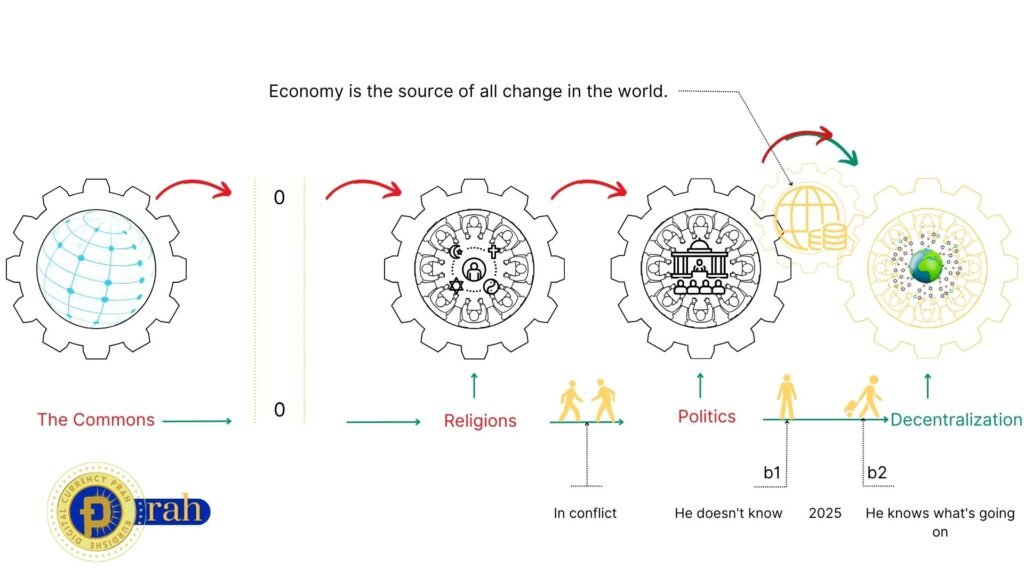
prah Governance Architecture (Internal System View)
PRAH
Governance Layer
Decentralised Coordination and Institutional Governance Framework
Full Expanded Document — Standalone Reference Version 1 | Reference Covenant: 2021.09.19 Internal Document — Kurdish Community
"The deepest crisis facing communities today is not military weakness alone, nor economic weakness alone. It is the collapse of the organising contract between individuals, leadership, institutions, and future generations." — PRAH Foundational Covenant
Preamble: Why Governance Is Not Administrative — It Is Civilisational
The Kurdish community has participated in nearly every major transformation that shaped the modern Middle East — militarily, politically, economically, and culturally. It fought in every war. It contributed to every revolution. It paid the price of every territorial rearrangement.
Yet this participation has consistently taken place within the projects of others.
Not because of the absence of talent, will, or resources. Because of the absence of a governance system the community could call its own.
Three contracts were offered across the modern era — the religious contract, the national contract, and the revolutionary contract. Each was broken by those who held the power to enforce it. The Kurdish community, denied that centralised power, never had the institutional capacity to break them. Its record remained clean — not through virtue alone, but through structural exclusion from the mechanisms of betrayal.
That exclusion ends here.
PRAH governance is not designed to administer a project. It is designed to build the institutional infrastructure that the Kurdish community was denied — transparent, distributed, accountable, and designed to survive generations.
Governance within PRAH is the living expression of the Foundational Covenant: the operational answer to the question the Kurdish community has faced for a century — how does a dispersed people organise collective action without surrendering collective destiny?
Part One: Governance Philosophy
1.1 Participation Before Authority
Authority within the system does not emerge from ownership, inherited status, wealth, or political affiliation.
Governance participation is linked to:
- measurable contribution,
- consistency of engagement,
- network activity,
- and long-term commitment to the community's objectives.
The objective is a system where influence reflects constructive participation rather than passive positioning or factional loyalty.
This principle directly addresses one of the most recurring failure patterns in Kurdish institutional history: the capture of collective structures by individuals or factions whose authority rested on personality or external backing rather than demonstrated service to the community.
Within PRAH, no position is permanent. No individual is above accountability. Every role exists to serve the network, not to control it.
1.2 Transparency as Infrastructure
Transparency is treated as a structural requirement — not a symbolic commitment, not a public relations gesture, and not an aspiration subject to discretionary interpretation.
Governance systems must allow every participant to:
- verify decisions and their basis,
- review processes before and after execution,
- monitor treasury allocations and outcomes,
- and evaluate governance performance over time.
This is not idealism. It is a direct response to the informal networks of loyalty, secrecy, and selective accountability that have repeatedly captured and fragmented Kurdish political and social institutions.
What can be verified cannot be falsified. What is documented cannot be quietly revised. What is open cannot be monopolised.
Transparency within PRAH is therefore the structural replacement for trust based on personal relationships — which has historically proven insufficient to sustain institutions across generations and political cycles.
1.3 Progressive Decentralisation
PRAH does not attempt full decentralisation from the outset.
Early-stage distributed systems require periods of structured coordination to maintain operational stability, protect infrastructure, and ensure that governance capacity develops at a pace the community can sustain and verify.
Decentralisation therefore develops through four sequential conditions:
- Community growth and participation base expansion.
- Governance maturity and demonstrated decision-making capacity.
- Infrastructure development sufficient to support distributed authority.
- Increased community capacity for accountability and self-correction.
The objective is not maximum decentralisation as an ideological endpoint. The objective is sustainable organisational independence — a system that cannot be captured, cannot be collapsed by the removal of any single actor, and cannot be redirected by external pressure.
1.4 Governance Through Coordination, Not Control
The purpose of governance is not centralised dominance over participants.
Its function is to:
- facilitate cooperation across geographic, political, and generational divides,
- reduce internal fragmentation without imposing artificial uniformity,
- organise incentives so that contribution to the network is individually rational,
- and align distributed activity toward shared long-term objectives.
Governance exists to strengthen the network. Not to restrict it. Not to own it. Not to represent it before it has chosen its own representatives.
Part Two: Governance Architecture
2.1 The Three Layers
PRAH governance operates across three developmental layers that evolve sequentially as the ecosystem matures.
Layer One — Foundational Coordination
This layer consists of the initial operational and strategic teams responsible for:
- infrastructure development and technical deployment,
- legal review and jurisdictional compliance,
- organisational stability during the formative period,
- and early-stage ecosystem expansion.
This layer holds authority not by right but by necessity — the temporary necessity of any early-stage system that requires stable coordination before distributed governance is operationally viable.
Its legitimacy is therefore explicitly transitional. As the community grows and governance capacity matures, influence and authority transfer progressively toward the broader participation base.
No position within this layer is permanent. No founder retains authority beyond the period for which it serves the covenant's objectives. The covenant survives its founders — or it was never a genuine structure.
Layer Two — Community Participation
The community layer represents the broad participation base of the PRAH ecosystem.
Participants contribute through:
- governance proposal submission and review,
- strategic discussion and collective feedback,
- operational participation in funded initiatives,
- mentorship and knowledge transfer within the network,
- and ecosystem activity that builds institutional memory.
This layer is not passive. It is the primary source of the network's long-term legitimacy. Every governance cycle in which the community participates actively renews the covenant — demonstrating that the system is not symbolic but functional, not inherited but practised.
Layer Three — Specialised Governance Units
As the ecosystem expands, governance functions are distributed across specialised operational divisions:
| Governance Unit | Primary Responsibility |
|---|---|
| Technical Governance | Protocol security, infrastructure, development standards |
| Economic Governance | Treasury management, sustainability systems, allocation review |
| Community Governance | Participation coordination, conflict mediation, onboarding |
| Educational Governance | Knowledge systems, training infrastructure, learning archives |
| Cultural Governance | Language preservation, cultural documentation, historical archives |
| Strategic Relations | External partnerships, institutional engagement, representation |
| Media Governance | Communication infrastructure, public representation, narrative |
These units function as coordinating environments — not isolated power centres. Each unit operates under the same transparency, accountability, and participation principles that govern the network as a whole. No unit holds authority over any other. Coordination between units occurs through documented inter-unit processes subject to community review.
2.2 Identity and Governance Rights
Governance participation within PRAH is connected to verified digital identity — not to financial holdings.
This is a foundational design decision. In systems where governance rights are proportional to token holdings, those with the most capital hold the most authority. This reproduces within digital networks the same concentration of power that has failed communities in traditional political systems.
PRAH governance rights scale with participation level:
Level 0 — Network entry (wallet only)
Basic access, no governance rights
Level 1 — Basic member (verified contact)
Access to community discussions
Level 2 — Verified member (documented credentials)
Full governance participation rights
Proposal submission
Voting rights
Level 3 — Contributing member (active participation record)
Expanded governance weight
Eligible for specialised unit participation
Level 4 — Delegated representative (community nomination)
Specialised governance responsibilities
Accountable to the community, not to founders
Identity records include:
- participation history and contribution record,
- governance activity (proposals submitted, votes cast, delegations made),
- verified credentials (academic, professional, cultural),
- and reputation metrics based on measurable network contribution.
Privacy Principle: Identity operates on selective disclosure. Members can prove they hold a credential or meet a participation threshold without revealing the full content of their records. Verification confirms the fact — not the document.
Part Three: Decision-Making Systems
3.1 The Decision Cycle
All governance decisions within PRAH follow a structured cycle designed to balance efficiency with genuine participation:
Stage 1 — Proposal
Any Level 2+ member may submit a proposal.
Requires minimum community support threshold to advance.
Proposals must include: objective, rationale,
resource requirements, success criteria.
Stage 2 — Discussion (open period)
All proposals debated on the open governance platform.
Amendments are documented and tracked.
All participants may contribute to discussion.
Stage 3 — Voting (open period)
Quadratic voting system (see 3.2).
Delegation permitted and revocable at any time.
Voting period allows participation across time zones.
Stage 4 — Review Period
Final opportunity for objection.
Supermajority required to block execution.
All objections documented publicly.
Stage 5 — Execution
Automatic execution via smart contract where applicable.
Full transparency report generated immediately.
Outcomes tracked against stated success criteria.
3.2 Voting Mechanisms
Quadratic Voting: PRAH uses quadratic voting to prevent governance capture by wealth concentration or factional blocs. Under quadratic voting, the cost of additional votes increases exponentially — meaning that casting ten votes costs one hundred units of voting weight, not ten. This preserves the ability of smaller participants to influence outcomes while preventing any single actor from dominating governance through financial resources alone.
Liquid Delegation: Members may delegate their voting weight to trusted representatives at any time. Delegation is:
- voluntary and revocable with immediate effect,
- transparent and publicly recorded,
- never permanent and never binding beyond individual decisions.
This allows community members who lack time or expertise on specific issues to remain effectively represented without surrendering their long-term governance rights.
3.3 Decision Classification
Not all decisions require identical governance procedures. The system distinguishes between:
| Decision Type | Governance Method | Threshold |
|---|---|---|
| Community proposals | Open review and voting | Simple majority |
| Treasury allocations | Multi-layer approval | Enhanced majority |
| Strategic direction | Broad governance participation | Enhanced majority |
| Covenant amendments | Full community process | Supermajority (66%+) |
| Emergency responses | Temporary operational authority | Post-action review required |
| Technical security | Specialised technical review | Documented outcome required |
Covenant amendments — changes to the foundational principles, rights, or governance architecture — require the highest threshold and the longest deliberation period. The covenant is designed to be stable and trustworthy. It is not designed to be easily amended by temporary majorities.
Part Four: Treasury and Resource Governance
4.1 Governance of Collective Resources
Economic sustainability requires transparent resource management. The PRAH treasury is governed collectively — no single actor, including founders, can access or direct treasury resources unilaterally.
Treasury oversight covers:
- ecosystem development funding,
- community initiative allocations,
- educational and cultural programme support,
- operational infrastructure maintenance,
- emergency response reserves,
- and long-term sustainability funds.
4.2 Treasury Security Principles
- Multi-signature requirement: All treasury operations require multiple signatures from geographically distributed, community-nominated signatories.
- Daily spending limits: Automatic circuit breakers halt activity that exceeds established parameters.
- Public audit trail: All allocations are documented on the open network and subject to community review.
- No founder override: No individual — including founding members — can bypass treasury governance procedures.
4.3 Allocation Priorities
Treasury allocations are governed by the values established in the Foundational Covenant:
- Knowledge and education: The primary long-term asset of the community.
- Cultural continuity: Language, archives, and intergenerational memory.
- Infrastructure: The technical systems that make participation possible.
- Emergency response: Support for community members in crisis situations.
- Strategic development: Capacity-building for long-term institutional growth.
The least advantaged members of the network are not a burden on the treasury. Their protection is evidence of the covenant's legitimacy.
Part Five: Conflict Resolution
5.1 Why Conflict Is Not Failure
Distributed systems that bring together diverse participants across different geographies, political backgrounds, and cultural contexts will inevitably generate disagreement and competing priorities.
Within PRAH, disagreement is not a failure to be suppressed. It is a governance input to be processed through organised mechanisms.
The objective is not the elimination of disagreement. It is the prevention of fragmentation — the collapse of coordination that occurs when disagreement has no legitimate channel for resolution.
5.2 Resolution Mechanisms
Structured mediation: Designated governance facilitators support parties in disagreement to document their positions, identify shared interests, and develop proposals for community review.
Proposal review: Disputed decisions can be submitted for formal re-review through the governance cycle, with extended discussion periods and enhanced documentation requirements.
Procedural clarification: Where disagreement concerns interpretation of governance rules rather than substantive decisions, the relevant specialised governance unit provides binding clarification subject to community appeal.
Escalation: Unresolved disputes may be escalated to full community governance processes with enhanced participation requirements.
All conflict resolution processes are documented publicly. Resolution outcomes are binding on all parties within the governance system.
5.3 Protection Against Four Historical Failures
The governance architecture is specifically designed to address the recurring failure patterns identified in Kurdish institutional history:
| Historical Failure Pattern | Governance Design Response |
|---|---|
| Personality-based authority | No permanent roles; legitimacy is continuously renewable |
| Factional capture | Quadratic voting; no bloc dominates; delegation is revocable |
| External dependency and manipulation | Treasury is internal; no external actor controls allocations |
| Fragmentation under political pressure | Documented processes survive individual departures |
Part Six: Governance Evolution
6.1 The Living Governance System
The governance framework is explicitly designed to evolve. It is a living coordination system, not a fixed ideological structure.
As the ecosystem matures, governance structures expand through:
- increased decentralisation of authority,
- new governance tools developed in response to community needs,
- broader participation systems as the network grows,
- and adaptive institutional models that respond to changing conditions.
Each major governance evolution is itself subject to governance — proposed, discussed, voted on, and documented in the same way as any other significant decision.
6.2 Intergenerational Governance
The covenant is designed to outlive its founders. Every generation inherits:
- responsibilities and accountability frameworks,
- accumulated knowledge and institutional memory,
- documented lessons from previous governance cycles,
- and the full participation rights of the covenant.
No generation inherits authority without accountability. No generation is bound by decisions made without their participation. The covenant survives precisely because it is larger than any individual or founding generation.
6.3 Governance and External Systems
PRAH governance is designed to interact constructively with:
- digital economies and global financial networks,
- educational institutions and research environments,
- private-sector networks and technology platforms,
- and international civil society and advocacy organisations.
The objective is to expand cooperative capacity while maintaining internal organisational independence. External partnerships are welcomed. External control of internal governance is structurally prevented.
Part Seven: Governance and the Foundational Covenant
7.1 The Relationship Between Covenant and Governance
The Foundational Covenant defines who we are, what we value, and what we will not concede.
The Governance Layer translates those commitments into verifiable daily practice: who decides, how they decide, what they can allocate, and how they are held accountable.
Neither document is complete without the other. The Covenant without governance is aspiration. Governance without the Covenant is administration without purpose.
Together, they form the complete answer to the structural challenge the Kurdish community has faced across the modern era: the need for a coordination system that is simultaneously:
- principled enough to be trusted,
- transparent enough to be verified,
- distributed enough to resist capture,
- and durable enough to survive generations.
7.2 The Fingerprint in Governance
The five foundational values established in the Covenant are expressed directly in governance design:
| Foundational Value | Governance Expression |
|---|---|
| Dignity before submission | No governance participant is above accountability |
| Diversity as organised strength | Quadratic voting; no single faction dominates |
| Continuity with land and nature | Environmental governance unit; sustainability allocation priority |
| Knowledge as strategic capital | Educational governance; knowledge treasury allocation |
| Justice as the basis of partnership | Transparent processes; protection of least advantaged members |
Conclusion
The PRAH Governance Layer exists to transform distributed participation into sustainable institutional coordination.
Its role is not to centralise authority. It is to create systems through which:
- trust becomes operational rather than personal,
- participation becomes organised rather than reactive,
- responsibility becomes measurable rather than symbolic,
- and collective activity becomes scalable across generations and geographies.
The long-term strength of PRAH depends not only on technology or economics — but on the ability to build governance systems capable of adapting, coordinating, and sustaining cooperation across a distributed global network that has been denied institutional continuity for far too long.
A people who govern themselves honestly need not ask permission from those who have governed them dishonestly.
A community that documents its decisions transparently cannot be told its history did not happen.
An institution designed to survive its founders is the only institution worth building.
PRAH Project — Governance Layer Documentation prah-kpr.com | prah-kpr.com/digital-governance/ Reference Covenant: 2021.09.19 For the full technical protocol architecture, see: Technical and Structural Framework (Document Two)