Our Community.
The prah ecosystem is built around three essential pillars that work together to transform ideas into opportunities, opportunities into projects, and projects into sustainable institutions.
Whether you wish to learn, contribute, build, support, or lead, there is a place for you within this growing community.
Choose the path that best matches your interests, skills, and aspirations.
Why a Currency Community.
Digital assets alone do not create lasting value.
Technology alone does not build sustainable ecosystems.
And capital alone does not create strong institutions.
The long-term strength of any economic system depends on the people who participate in it, the relationships they build, and the value they create together.
For this reason, prah views the community as the true foundation of the ecosystem rather than a group of passive observers surrounding a digital asset.
The purpose of the prah Community is not simply to support a token.
Its purpose is to create an environment where participation, cooperation, knowledge, and contribution can be transformed into opportunities, initiatives, and long-term institutional capacity.
Within this model:
• Participation creates value.
• Contribution builds trust.
• Trust strengthens cooperation.
• Cooperation expands opportunity.
• Opportunity supports growth.
The token is therefore not viewed as the source of value itself, but as a tool that helps coordinate activity, recognize contribution, and support the development of the wider ecosystem.
A strong community generates ideas.
A coordinated community builds projects.
A productive community creates institutions.
And institutions capable of creating value can support future generations.
The objective of prah is not simply to gather people around a digital asset.
It is to help create a community capable of building knowledge, opportunities, institutions, and sustainable value together.
- Value does not begin with money or technology, but with the person who decides to share.
1-Community Members.
The foundation of every successful ecosystem begins with an active and engaged community.
Community members participate through discussions, events, educational activities, social media engagement, community initiatives, and knowledge sharing.
This path is designed for individuals who wish to learn, connect, participate, and contribute to the growth of the ecosystem.
Activities may include:
• Following official channels
• Participating in community discussions
• Attending spaces and events
• Sharing project updates
• Supporting community initiatives
• Building networks and relationships
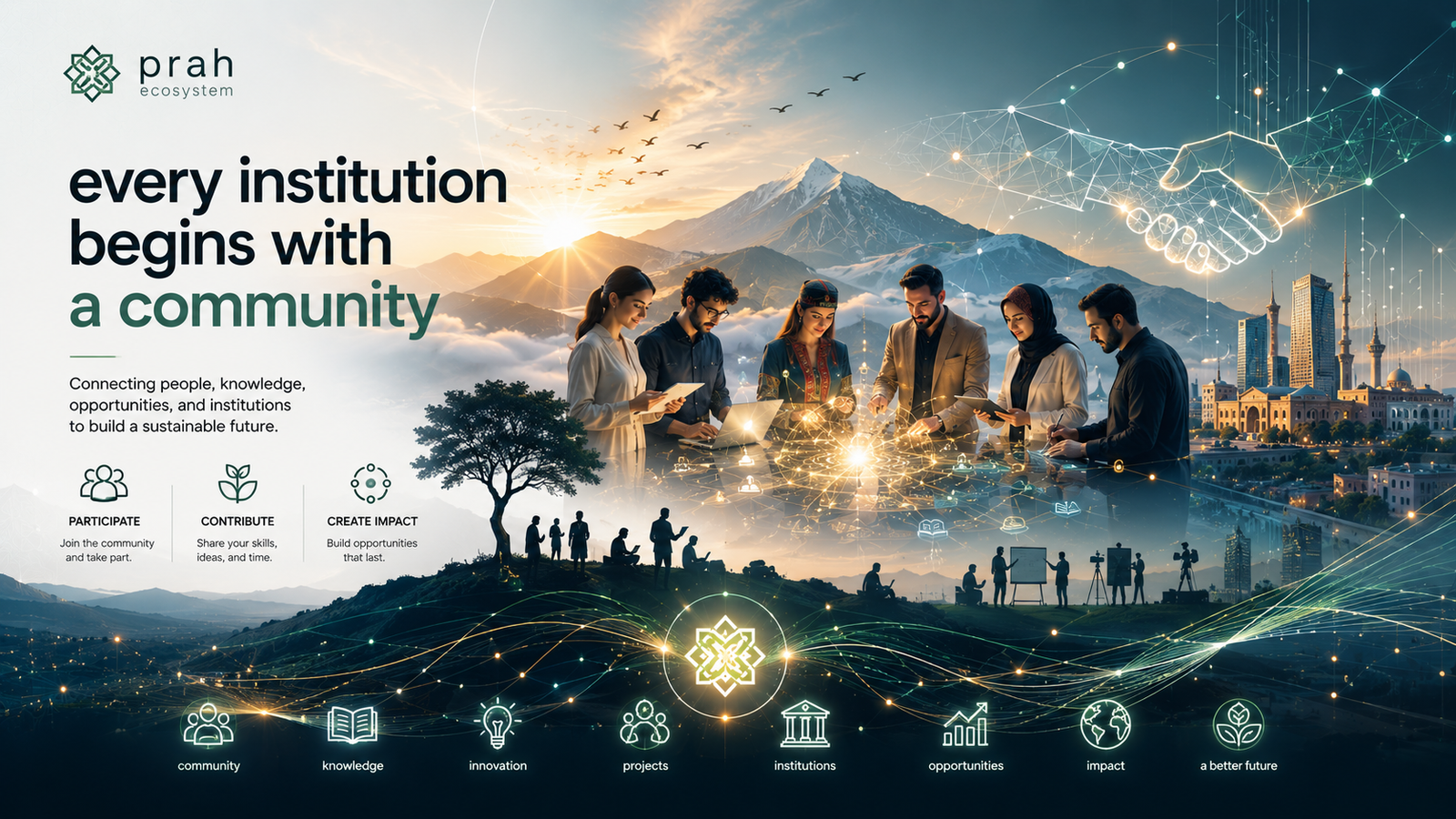
Every institution begins with a community.
2-Professional Contributors.
Knowledge, expertise, and professional skills are among the most valuable resources within any community.
This path is designed for researchers, developers, designers, economists, educators, media professionals, translators, project managers, legal experts, and specialists from various fields.
Contributors may participate in:
• Research and analysis
• Technology development
• Media and communication
• Education and training
• Governance and policy
• Project development
• Institutional building
As the ecosystem grows, contributors may join specialized teams, initiatives, and future institutions.
3-Supporters & Contributors.
Communities grow through participation, expertise, resources, and support.
This section welcomes individuals, organizations, entrepreneurs, partners, and supporters who wish to contribute to the development of the ecosystem.
Support may take many forms:
• Financial contributions
• Strategic partnerships
• Mentorship and guidance
• Resources and infrastructure
• Community initiatives
• Opportunity creation
Every contribution helps strengthen the ecosystem and expand its ability to create value for future generations.
4-How Value Is Created.
How Value Is Created
Within the PRAH program, value does not arise from the token alone.
Value is created when individuals contribute knowledge, time, expertise, relationships, resources, and ideas.
As these contributions accumulate, the community grows stronger.
A stronger community creates more opportunities.
Opportunities give rise to projects.
Projects evolve into enterprises.
Enterprises generate sustainable economic, social, and educational impact.
This is how participation becomes value, and value becomes growth.
Join the Journey.
The future is not built by technology alone.
Nor by capital alone.
Nor by institutions alone.
It is built when individuals choose to learn, collaborate, and contribute to something greater than their own personal interests.
PRAH is founded on a simple belief:
That communities capable of organizing knowledge, coordinating talent, sharing responsibility, and building trust can create opportunities and achievements beyond the reach of any single individual.
Every discussion holds value.
Every contribution makes an impact.
Every skill has a place.
And every initiative can be the start of something greater.
Some contributions may seem small at first, yet many institutions that have touched millions of lives began with a single idea, a conversation, a volunteer, a researcher, a developer, or a supporter who decided to take that first step.
Whether you choose to be a community member, a contributor, a specialist, a supporter, or a future partner, you become part of a journey that seeks to transform participation into value, value into opportunities, and opportunities into a lasting impact that serves future generations.
Every journey begins with a single step.
We invite you to begin this journey with us.