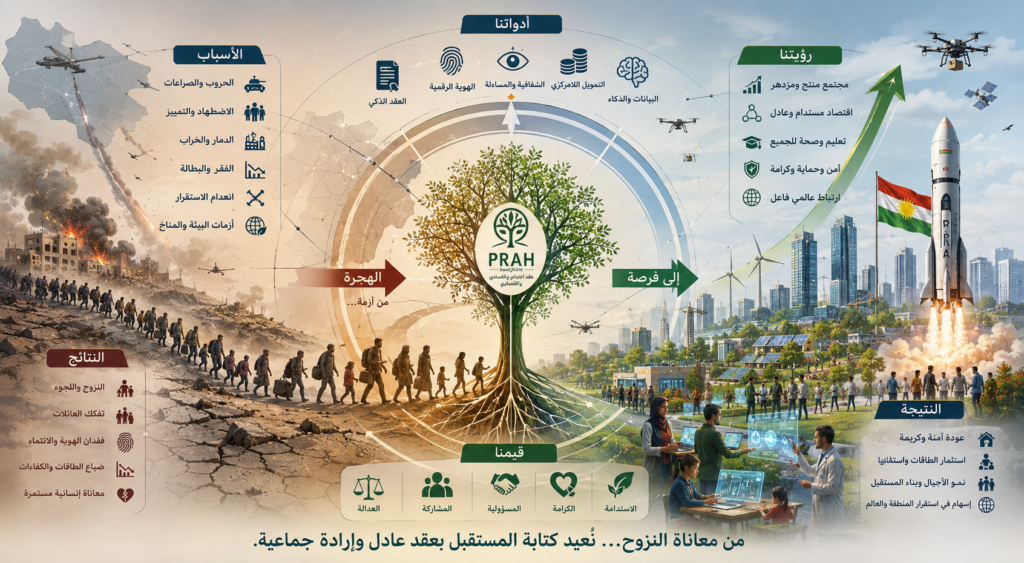
The Founding Charter of the prah al-Kurdi Project
Core Premise: Money, politics, and belief are not separate domains — they are intertwined tools that shape the destinies of individuals and communities.
Those who do not understand money are bought and sold. Those who do not understand politics are exploited, then discarded. Those who do not understand belief are manipulated in its name — driven toward their own destruction while convinced they are defending a righteous cause.
Those who treat these tools as separate, or reduce them to slogans and good intentions, will possess neither decision-making authority, nor sovereignty, nor the capacity to object when fateful decisions are made on their behalf.
History is not written by ethics alone, nor by abstract faith, nor by brute force — but by a precise balance between economic value, political power, and the meaning people choose for themselves.
The Living Kurdish Founders Covenant
Document One of Two — Philosophical & Foundational Framework
Version 5 | Reference Contract: 2021.09.19 Internal Founders Document — Kurdish Community
"Where there is no covenant, there is no commitment."
Preamble
Communities do not survive through emotion alone. Nor through memory alone. Nor through weapons alone.
They survive when they possess:
- a shared meaning,
- an organised system of trust,
- continuity across generations,
- and the capacity to coordinate collective interests without dissolving into dependency.
Money, politics, technology, culture, and belief are not separate domains. They are instruments through which societies organise power, preserve memory, and protect their future.
A people who do not understand economics become dependent. A people who do not understand governance become fragmented. A people who do not understand narrative and meaning become vulnerable to manipulation in the name of causes they did not define themselves.
History is not shaped by slogans or moral claims alone. It is shaped by organised communities capable of transforming values into systems, systems into institutions, and institutions into continuity.
PRAH is not founded as a currency project. Nor as a political party. Nor as a temporary movement reacting to crisis.
PRAH is founded as a long-term Kurdish functional covenant: a living framework for coordination, trust, identity, participation, and intergenerational continuity.
Technology within PRAH is not the purpose. It is the infrastructure.
Part One: The Philosophical Foundation — Why the Contract?
Part One: The Philosophical Foundation
1.1 The Crisis of Broken Structures
Modern history produced a repeated crisis across nearly every society in the region: states without trust, constitutions without enforcement, identities without protection, economies without justice, and alliances without continuity.
Communities were asked to sacrifice continuously without possessing genuine participation in shaping the systems governing them.
The Kurdish experience represents one of the clearest examples of this contradiction: participation without protection, loyalty without guarantees, and contribution without recognised sovereignty over collective destiny.
The result was not only political fragmentation — but the fragmentation of trust itself.
The deepest crisis facing communities today is therefore not military weakness alone, nor economic weakness alone. It is the collapse of the organising contract between individuals, leadership, institutions, and future generations.
1.2 The Three Broken Contracts
The modern history of the region can be read as a sequence of contracts made and broken:
The Religious Contract promised brotherhood that transcended race and origin. What followed was families and tribes sheltering under the religious banner to divide the spoils of new states. Islam became a cover for nationalist projects, not a creed for equal brotherhood.
The National Contract promised equal citizenship regardless of origin or ethnicity. What followed were constitutions written and ignored, minorities required to assimilate through dissolution rather than belonging.
The Revolutionary Contract promised liberation of the oppressed and redistribution of power. What followed was every revolution producing a new despotism that wielded the language of revolution to perpetuate domination — states becoming spoils managed by external agendas and foreign funding.
The Legal and Philosophical Principle: Whoever breaks a contract first forfeits the right to invoke it. The Kurdish people were never granted the centralised power to become the principal architects of regional betrayal. They repeatedly experienced exclusion, denial, forced assimilation, and fragmentation imposed from outside.
This does not create superiority. But it creates entitlement: the entitlement to organise independently, to document collectively, and to establish internal systems capable of protecting continuity where external guarantees repeatedly failed.
The PRAH Covenant is therefore not founded on revenge, nor on isolation. It is founded on organised continuity.
1.3 From the Social Contract to the Living Covenant
Classical political philosophy attempted to answer one enduring question: what gives legitimacy to authority?
Three major answers shaped modern political history:
Divine Legitimacy — Authority descended from sacred mandate. This model endured until societies discovered a fundamental contradiction: human rulers are imperfect, while divine perfection cannot be questioned.
Power and Protection — Hobbes argued that security justifies authority. People obey because disorder is more destructive than submission. Yet even Hobbes recognised that power alone cannot sustain legitimacy indefinitely without acceptance.
The Social Contract — Rousseau introduced the enduring principle: legitimacy emerges from collective agreement and delegated trust. Authority is not ownership. It is temporary custodianship.
The PRAH Covenant extends this principle into the digital and networked age. A legitimate system is no longer defined only by territory or institutions. It is defined by continuity of participation, verifiable trust, organised cooperation, and shared long-term interests.
Part Two: The Theory of the Living Covenant
2.1 From Static Documents to Living Systems
Traditional charters relied on static texts: constitutions, agreements, and declarations. But history repeatedly demonstrated that a text without living mechanisms becomes symbolic memory rather than functional structure.
A living covenant differs from a rigid contract in four fundamental ways:
| Traditional Contract | Living Covenant |
|---|---|
| Signed once | Renewed through participation |
| Dependent on institutions | Supported by distributed systems |
| Vulnerable to central collapse | Resilient through decentralisation |
| Preserved by force | Preserved by collective benefit |
The PRAH Covenant measures legitimacy not through slogans or declarations, but through continued participation and contribution.
2.2 Delegation and Collective Custodianship
Delegation is the foundation of every functioning society. But delegation within PRAH is not permanent ownership of authority. It is conditional custodianship governed by three principles:
Principle One — Service Before Control: Authority exists to coordinate the community, not dominate it.
Principle Two — Transparency Before Loyalty: No internal actor is above documentation, review, or accountability.
Principle Three — Continuity Before Personality: No individual represents the project permanently. The covenant survives generations precisely because it is larger than its founders.
The project therefore rejects personality cults, inherited authority, and political absolutism in all forms.
2.3 Currency as an Encoded Social Contract
Currency is not merely a medium of exchange — it is a social contract. When you accept a currency in exchange for a service, you implicitly accept the community that issued it, the law that protects it, and the network that recognises it.
Issuing currency is therefore a sovereign act. Within PRAH, the digital currency is not a speculative instrument. It is a digital embodiment of the Kurdish social contract. Every use of it is implicit acceptance of the Covenant's rules, commitment to the shared value system, and participation in building sovereignty from below rather than awaiting it from above.
Part Three: The Architecture of the Covenant — Seven Pillars
Pillar One: Functional Sovereignty, Not Geographic Dependency
Traditional sovereignty depended entirely on territory. Dispersed communities require another model: the capacity to perform collective functions regardless of borders — education, identity, representation, documentation, trust, coordination, and collective continuity — without waiting for external permission.
Pillar Two: Trust as Infrastructure
Trust cannot survive on intentions alone. It requires systems where betrayal becomes costly, contribution becomes visible, and accountability becomes permanent. Transparency, decentralisation, and verifiable documentation are therefore ethical necessities — not merely technical features.
Pillar Three: Participation as the Condition of Belonging
Belonging is demonstrated through practice. Participation itself renews the covenant: contribution, consultation, cooperation, mentorship, documentation, and collective responsibility. Passive symbolism alone cannot sustain a living community.
Pillar Four: Intergenerational Continuity
The covenant is designed to outlive its founders. Every generation inherits responsibilities, accumulated knowledge, institutional memory, and documented lessons. The goal is not temporary mobilisation. It is civilisational continuity.
Pillar Five: The Internal Covenant Before External Alliances
No external partnership can compensate for internal fragmentation. Before negotiating with states, corporations, or organisations, the community must establish non-negotiable principles, internal accountability, and documented consultation mechanisms. Communities without internal cohesion become negotiable piece by piece.
Pillar Six: Justice as the Condition of Sustainability
Any system concentrating all power or wealth into narrow circles eventually collapses into internal distrust. Justice within PRAH means opportunity, transparency, participation, and protection of the least advantaged members of the network. The weakest member is not a burden on the covenant. Their protection is proof of its legitimacy.
Pillar Seven: Peace Through Structured Interdependence
Durable peace does not emerge from declarations alone. It emerges when communities become economically, intellectually, and socially interconnected in ways that make destruction mutually harmful. The PRAH model seeks constructive interdependence, cooperation, and resilience through networks of shared interests.
Part Four: The Kurdish Founders Fingerprint
4.1 The Correct Exit — Why This Framework, Why Now
Exiting broken contracts does not mean random rupture. It means extracting what was true within them and building what was absent from them.
The Kurdish community was a genuine partner in these systems for centuries. It paid the price in blood, displacement, and confiscated culture. From this very price paid emerges the entitlement to define its own fingerprint — not from a vacuum, nor by imitating another model, but from the capital of a lived experience that did not break.
The correct exit means: we take with us what we have earned, we name what we believe in, and we define what we will not concede — before entering into any new contract with ourselves or with others.
4.2 The Foundational Value Set
Value One — Dignity Before Submission: Collective dignity is treated as foundational infrastructure, not symbolic rhetoric. One who does not sell their dignity does not sell their partner. This is not sentiment — it is a trust signal.
Value Two — Diversity as Organised Strength: Multiple Kurdish dialects, geographic diversity, centuries of coexistence with different religions and cultures — all described as fragmentation, all in truth wealth of adaptation. Internal plurality is preserved and coordinated rather than erased.
Value Three — Continuity With Land and Nature: The Kurdish community is historically a mountain community — its relationship with land is one of destiny, not merely ownership. In the context of the global environmental crisis, this is not folklore. It is a strategic argument and a knowledge asset.
Value Four — Knowledge as Strategic Capital: When land is confiscated, the mind remains. Education, science, and intellectual production are considered the primary long-term assets of the community — the first thing we invest in and the last thing we concede.
Value Five — Justice as the Basis of Partnership: No partnership founded on anything other than defined and measurable justice can endure. This principle governs internal and external relationships alike.
4.3 The Collective Interest Set
The PRAH community seeks:
- organised continuity,
- coordinated self-representation,
- intellectual and economic resilience,
- intergenerational stability,
- and independent decision-making capacity.
The overarching interest: building an autonomous economic and identity system that makes the Kurdish community a partner, not a dependent, in any regional or international arrangement — and makes its absence from the table costly to those who wish to sit at it.
4.4 The Non-Negotiable Rights Set
First Tier — Non-Negotiable:
- The right to language in all its dialects.
- The right to collective memory and recognition of historical crimes.
- The right to self-representation — no external party speaks about or for the Kurds without explicit documented delegation.
- The right to security — the community cannot be used as fuel in others' conflicts without specific and guaranteed consideration.
- The right to cultural continuity.
Second Tier — Negotiable in Form, Not in Substance: The form of governance may evolve. Mechanisms may adapt. Technologies may change. But the substance of dignity, participation, and continuity remains non-negotiable.
4.5 The Complete Entry Equation
Any contract offered — internal or external — must pass through this triangle:
         Fingerprint (who are we?)
                  ▲
                  │
 Interests ◄──────┼──────► Rights
(what do we seek?)     (what will we not concede?)
Three questions for every proposed contract:
- Does it respect our fingerprint, or condition its alteration?
- Does it serve our defined interests, or turn us into an instrument for others?
- Does it guarantee our fixed rights, or demand their prior concession?
Yes to all three — we enter. No to any — we negotiate. Persistent refusal — we build without them.
Part Five: The Founders Covenant
5.1 Custodianship, Not Ownership
No founder owns PRAH. Founders are custodians of an evolving covenant whose legitimacy depends on future generations continuing to choose participation freely.
5.2 Protection Against Internal Corruption
Every historical movement risks eventual capture by ego, secrecy, opportunism, external dependency, or concentration of influence. The covenant therefore requires transparency, distributed responsibility, documented processes, and renewable legitimacy.
5.3 The Principle of Generational Transfer
A project that cannot survive its founders was never a genuine structure. The purpose of PRAH is not temporary leadership. It is the creation of durable civilisational infrastructure capable of surviving political cycles, crises, technologies, and generations.
Final Principle
This covenant does not ask for blind belief.
It asks for participation, responsibility, continuity, and measurable contribution.
A covenant gains legitimacy only through practice. A community survives only when it learns how to organise trust across generations.
PRAH Project — Internal Founders Covenant for the Kurdish Community prah-kpr.com | Reference Covenant: 2021.09.19
prah.The Structural and Technical Framework
Document Two of Two — Protocol Architecture & Implementation
Version 5 | Reference Contract: 2021.09.19 Internal Founders Document — Kurdish Community
"Technology within PRAH is not the purpose. It is the infrastructure."
Executive Summary
PRAH is a long-term Kurdish functional coordination protocol. It is not a currency project, a political party, or a temporary movement. It is a digital infrastructure designed to transform a geographically dispersed community — 35 to 65 million people across four countries and a global diaspora — into an organised, self-sustaining economic and institutional network.
This document covers:
- Why the protocol architecture was chosen
- What the three foundational layers do
- How the governance model operates
- What the roadmap looks like
- How this connects to the broader Kurdish structural challenge
The philosophical and foundational framework is covered in Document One.
Part One: Why PRAH Exists — The Structural Case
1.1 The Global Transition Underway
The world is transitioning from centralised institutions and geography-bound structures toward open networks, digital protocols, and borderless communities.
In this transition, the ability to coordinate, build trust, organise value, and connect people into productive networks is becoming more important than many of the traditional tools that defined the twentieth century.
This transition creates an opportunity that did not previously exist: a community without a centralised state can build functional sovereignty through protocol rather than through territory.
1.2 Three Shifts That Make This Possible Now
Shift One — From Territory to Network: Today's most influential global organisations do not necessarily control the largest territories or natural resources. They control the strongest networks, the largest user bases, and the most effective coordination systems. This has enabled new forms of economic communities capable of operating across borders.
Shift Two — From Institutions to Protocols: Confidence in traditional institutions — financial, political, and bureaucratic — has declined steadily. Trust has shifted toward systems that are transparent, verifiable, and protocol-based. This includes blockchain infrastructure, smart contracts, decentralised identity systems, and open governance models.
Trust is gradually moving from institutions to protocols.
Shift Three — From Centralised Identity to Digital Identity: Digital identity is no longer simply a form of verification. It is becoming an economic asset, a reputation layer, a contribution record, and an access mechanism for opportunities and services. For dispersed communities, this is transformative.
1.3 Why This Matters for the Kurdish Community Specifically
The Kurdish community currently possesses:
- a significant human presence (35–65 million people),
- diverse resources and historical experience,
- transnational social and cultural networks,
- a broad diaspora in Europe, America, and Australia,
- and substantial professional and academic talent in global institutions.
What it lacks is the coordination infrastructure to transform this potential into cumulative economic and institutional force. The problem has never been the absence of will, competence, or human potential. The problem has been the absence of a framework capable of organising these energies.
PRAH is designed to be that framework.
Part Two: The Three-Layer Architecture
Every productive network requires three foundational layers:
| Layer | Function | PRAH Component |
|---|---|---|
| Trust | Identity and reputation | Digital Identity Layer |
| Value | Exchange and incentives | Network Economy Layer |
| Coordination | Governance and organisation | Decentralised Governance Layer |
2.1 Layer One — Digital Identity
Digital identity within PRAH is not a secondary technical feature. It is core economic infrastructure.
What it does:
- Documents participation history and contribution record.
- Provides verifiable credentials (academic, professional, cultural).
- Creates a portable reputation that operates across borders and institutions.
- Links identity to governance rights within the protocol.
Verification Levels:
Level 0 — Wallet only (entry point)
     ↓
Level 1 — Basic member (verified contact)
     ↓
Level 2 — Verified member (documented credentials)
     ↓
Level 3 — Contributing member (active participation record)
     ↓
Level 4 — Delegated representative (community nomination)
Privacy Principle: Identity operates on selective disclosure. Members can prove they hold a credential without revealing its full content. Verification confirms the fact, not the document.
Why this matters: A Kurdish professional in Berlin, a student in Erbil, and a community leader in Stockholm can all participate in the same governance decisions, verify each other's contributions, and coordinate resources — without requiring any central institution to mediate between them.
2.2 Layer Two — Network Economy
The PRAH digital currency (EURN token) is not a speculative instrument. It is a functional tool for economic coordination within the network.
Core functions:
- Enables value transfer across borders without banking intermediaries.
- Finances community projects through collective decisions.
- Creates measurable economic incentives for contribution and participation.
- Builds an internal economy that is not dependent on any single national system.
Distribution principle: Initial distribution is free. There are no ICOs, no pre-sales, no speculative launch mechanisms. Tokens are distributed to participants to eliminate entry barriers and allow the network's actual usage to determine value.
What the currency is not:
- It is not a get-rich mechanism.
- It is not affiliated with any political movement.
- It does not provide financial advice or investment guarantees.
- It does not replace traditional economies.
What the currency is: A coordination tool that enables the community to fund its own priorities, reward contribution, and build economic independence gradually — starting from the smallest unit of participation.
2.3 Layer Three — Decentralised Governance
The governance layer is what transforms the protocol from a financial tool into a genuine community coordination system.
Core mechanism: Decisions are made collectively through documented voting, with delegation rights that allow members to assign their votes to trusted representatives while retaining the ability to reclaim them at any time.
Decision cycle:
1. Proposal
   Any Level 2+ member can propose
   Requires minimum support threshold to advance

2. Discussion — open period
   All proposals debated on the network
   Amendments documented and tracked

3. Voting — open period
   Quadratic voting (prevents wealth concentration)
   Delegation permitted and revocable

4. Review period
   Final opportunity for objection
   Super-majority required to block

5. Execution
   Automatic via smart contract
   Full transparency report generated
Anti-capture principles:
- No founder holds permanent authority.
- No single actor controls the treasury.
- All processes are documented and publicly auditable.
- Legitimacy is renewed through participation, not inherited through position.
Part Three: The Twelve Structural Challenges PRAH Addresses
The following challenges were identified through community analysis. Each corresponds to a specific function within the protocol architecture.
1. Absence of a Unified Economic Identity A shared digital-economic infrastructure enables interaction, exchange, and accumulation within a transparent and measurable framework — without replacing existing economies.
2. Geographic Fragmentation and Diaspora Digital tools transform geographic dispersion from a weakness into a global interaction network. The diaspora becomes a source of strength rather than a condition of separation.
3. Weak Adaptation to Global Transformations The digital economy creates pathways for skill development, new employment opportunities, and integration into global markets — accessible to Kurdish youth wherever they are.
4. Lack of Organisational Transparency Every transaction and decision within PRAH is documented, verifiable, and open. The protocol reduces dependency on closed networks and personal relationships.
5. Weak Institutional Governance Economic accumulation creates the resources to finance and sustain independent institutions. Governance in this model is the direct outcome of organised economic and social systems.
6. Weak Cultural and Linguistic Capacities The network economy can fund digital content creation, language preservation infrastructure, cultural archives, and cross-community programmes.
7. Monopoly of Platforms and Alliances Financial freedom is a gateway to other freedoms. Relatively independent economic networks reduce vulnerability to external dependency and marginalisation.
8. Absence of Accountable Representative Leadership Legitimacy connected to contribution and measurable participation rather than slogans or traditional alignments. Voting systems make representation transparent and revocable.
9. Complex Regional and International Alliances An organised and relatively independent economy transforms relationships with external actors from dependency into mutual interests, expanding decision-making capacity.
10. Confusion Between Official and Private Entities Decentralised economic platforms allow cooperation with individuals, private institutions, digital platforms, and global economic networks — without requiring formal political recognition.
11. Weak Investment During Times of Crisis Long-term economic culture, accumulation capacity, and cooperation networks allow greater readiness to benefit from global transformations rather than only absorbing their negative consequences.
12. Brain Drain and Loss of Talent A more open digital-economic environment reconnects talent networks, links expertise between homeland and diaspora, and transforms migration from permanent loss into global knowledge cooperation.
Part Four: Blockchain Infrastructure
4.1 Technical Foundation
Base infrastructure: EVM-compatible blockchain (Ethereum Virtual Machine standard)
Rationale:
- Largest developer ecosystem globally.
- Full interoperability with major DeFi protocols.
- Mature security auditing tools.
- Layer 2 deployment for low-cost, high-speed transactions.
Existing contract: Published 2021-09-05 on TRON network. Verifiable at: tronscan.org/#/token20/TCfkMrDhTDJKQtzBu4KszLA76B7Fpkm6s2
4.2 Protocol Stack
┌─────────────────────────────────────────┐
│         Application Layer (dApps)        │
│   User Interface · Wallets · Dashboard   │
├─────────────────────────────────────────┤
│         Governance Layer                 │
│   Governor Contract · Voting · Timelock  │
├─────────────────────────────────────────┤
│         Identity Layer                   │
│   DID Standard · Verifiable Credentials  │
├─────────────────────────────────────────┤
│         Protocol Layer                   │
│   EURN Token · Treasury DAO · Staking    │
├─────────────────────────────────────────┤
│         Blockchain Layer (L2)            │
│   EVM Compatible · Low Cost · Fast       │
└─────────────────────────────────────────┘
4.3 Security Principles
- No central key: No single actor — including founders — can access the treasury alone.
- Multi-signature requirement: Critical operations require multiple signatures from geographically distributed signatories.
- Daily spending limits: Automatic circuit breakers halt unusual activity.
- Open source: All protocol code is publicly auditable.
- Independent security audits: Conducted before every major release.
Part Five: Roadmap
Phase Zero — Foundation (Completed 2021)
- Smart contract published on TRON network.
- Initial white paper released.
- Foundational covenant drafted.
Phase One — Network Building (12–18 months)
Target: 10,000 active members across three regions (Europe, North America, Middle East)
Milestones:
- Free token distribution to founding members.
- Digital identity registry launched (Levels 0–1).
- First 20 community projects funded through collective voting.
- Governance platform operational.
Success indicators:
- Member retention above 40% at six months.
- Minimum three projects with documented measurable outcomes.
Phase Two — Internal Economy (18–36 months)
Target: Internal exchange volume exceeding $1 million annually
Milestones:
- Professional services tokenised (translation, legal consultation, education, software development).
- Emergency fund operational for crisis response.
- University partnerships for scholarship and exchange programmes.
- 500+ active professional members within the network.
Phase Three — International Presence (36–60 months)
Target: Recognised institutional presence in at least one international forum
Milestones:
- Legal entity registered in appropriate jurisdiction.
- Parallel reports submitted to relevant UN bodies.
- Partnerships established with major Web3 organisations.
- First annual transparency report published.
Part Six: What PRAH Is Not
Given the complexity of the regional political environment, clarity on scope is essential:
| PRAH is | PRAH is not |
|---|---|
| An economic coordination protocol | A political party or movement |
| An open-source community project | A centralised institution |
| A tool for community self-organisation | A replacement for traditional governance |
| A long-term civilisational framework | A short-term crisis response |
| Politically non-affiliated | Aligned with any state, faction, or ideology |
PRAH does not provide financial advice. Participation is a personal decision. All participants bear full responsibility for assessing associated risks. All transactions are documented on an open network, and participants are responsible for independently verifying information.
Conclusion
The world is moving toward a reality where networks become more influential than borders, protocols become more important than bureaucracy, and digital trust becomes more valuable than centralised mediation.
In this emerging environment, communities capable of building their own coordination systems will participate in shaping the future. Those that remain dependent entirely on external systems will remain structurally peripheral to the next global order.
The Kurdish community possesses the human capital, the cultural depth, and — for the first time in modern history — the technological tools to build its own coordination system without requiring permission from any external authority.
PRAH is that system.
Not because it promises to solve every challenge at once. But because it builds the infrastructure through which solutions become possible: trust that can be verified, contribution that can be measured, decisions that can be made collectively, and continuity that can survive generations.
Real transformation does not begin with slogans. It begins with building structures capable of continuity, production, and adaptation within a rapidly changing world.
PRAH Project — Technical and Structural Framework prah-kpr.com | Reference Contract: 2021.09.19 Smart Contract: tronscan.org/#/token20/TCfkMrDhTDJKQtzBu4KszLA76B7Fpkm6s2